
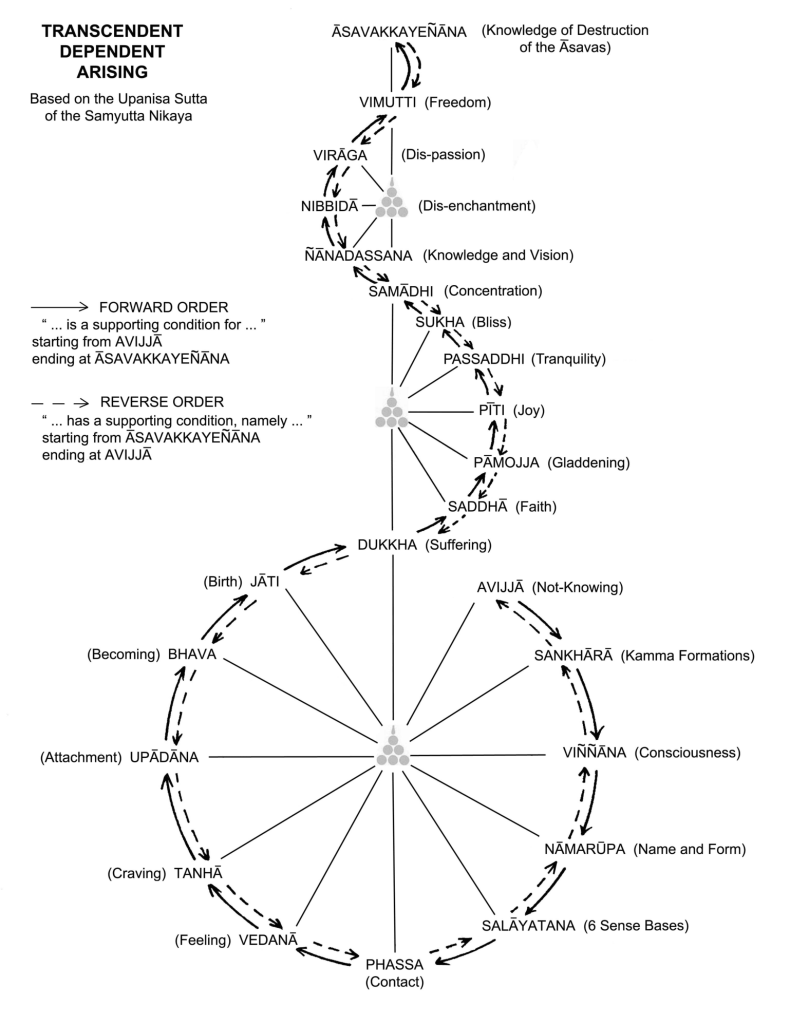
Above you can find a 2500 year old map. It is a combined map, listing two chains. Firstly, starting from ignorance (AVIJJA), there is the 12 links of mundane dependent arising. They are the necessary links required for the presence of suffering (DUKKHA), known as the first noble truth. Suffering also is itself a condition (SANKHARA) that is a cause for suffering: beings suffer because they suffer and they have avijja of the path leading to the cessation of that suffering. And that is the case for each of these 12 links: all twelve are conditions or sankharas that due to ignorance of their stressful nature continues the wheel of suffering. These causes and conditions dependent upon which there arises stress are known as the second noble truth.
Between ignorance and suffering the map points to a potential escape. It loops out into a second chain, starting with saddha and then eventually freedom and knowledge into the destruction of defilements. This chain is called the links of transcendental dependent arising. This is the third noble truth: dependent upon the cessation of any of the 12 links, there is the cessation of suffering. The path do to that, an eightfold practice, is the fourth noble truth.
Some people suffer but are ignorant of it. They dont know that they or those around them are suffering.
Some people experience or have suffering around them but know what it is and are aware of it.
This is the attainment of the first noble truth.
Some people are aware of suffering, but they don’t know the necessary conditions dependent upon which it arises.
Some people are aware of suffering, and they know the necessary conditions dependent upon which it arises.
This is the attainment of the second noble truth.
Some are aware of suffering and its causes. Yet they are ignorant of a practice dependent upon which the conditions for suffering cease.
There are those who do know the path dependent upon which these conditions cease.
This is the attainment of the third and fourth noble truth.
Ayya Khema called the noble truths the teachings of the Buddha in Telegram-style.
There is something interesting to these links that I want to talk about. Below is the list written out, next to an earlier version of these 12 links that Leigh Brasington writes about in his book. The list is taken from his third chapter of his book.
In that chapter, Leigh compares two lists of mundane dependent origination. He argues that it is likely that the 12 links are adapted from an earlier list of six links (listed on the right), which is found in the Sutta Nipata, a collection in the Pali Canon that is the oldest collection.
The suggestion he makes is that the lists have some correspondence to them. That is, if put next to each other, the lists are able to line up without changing the order.
12 link version | Version in Sutta Nipata
    Suffering     |  Suffering
    Birth         |
    Becoming      |
    Clinging      |  Endearing
    Craving       |  Desirable
    Vedanā        |  Pleasant & Unpleasant
    Sense-contact |  Sense-contact
    6 Senses      |
    Name-and-Form |  Name-and-Form
    Consciousness |
    Saṅkhāra      |
    Ignorance     |
One could say that if there are a variety of lists, then possibly one of the lists are wrong. But what Leigh points to is that there seems to be a correspondential function in the variety of lists. That is, throughout the collections of discourses there are many lists. And if looked at carefully, it seems they correspond to other lists. And rather than the Buddha pointing this out in each case, there seems to be an effort for the cultivation of some kind of network between these teachings. That is, a proper understanding and practice of these lists eventually would lead to these lists converging into SAMADHI (concentration), which in in 108 MN is described as all sorts of wholesome mental factors coalescing together in a way that allows it to enter, eventually, nibbana.
In addition to this correspondential function possibly describing a type of effort dependent upon wisdom leading into concentration and freedom, it also can cultivate wisdom about the paths that are listed separately. That is, the links of transcendent dependent arising are often taken from the upanisa sutta (12.23 SN), but taken from a coalescing perspective there can be a more unifiying perspective of what that path means.
That is, in addition to the lists of mundane dependent origination, I suggest there also is correspondence between the list of transcendental dependent origination in the upanisa sutta schematized above (from saddha to asavakkeyenna) and the list of transcendental dependent origination in the chapter on conscience and dignity (here translated as prudence) in AN 7:65.
What is interesting about this is that the first link out of suffering isn’t saddha. Rather, it is conscience and dignity.
It means that that there can be a sense of being stuck in patterns. And through conscience and dignity this is known. And through these one is called or guided to something different. There are several options.
For most people, it is that the conscience gets buried under the process of becoming. Holding on to what someone craves to possess, be, or not be, one becomes all sorts kinds of person that is differing from what what craved. And in turn that becoming becomes a SANKHARA, which due to ignorance about its arising and fall, can deepen a cycle of suffering – the whirlpool downwards – if the craving and holding on deepens until AVICI or incessant suffering.
The mind ‘dips’ or gets budged into all these conditions again and again. That is, until wisdom grows about which conditions lead to getting caught and how to avoid those processes. Until at some point some of these processes are broken off in successive stages. In Theravada, that is called NIBBANA (quenching).
 Meditation