
The paradigm of secularism operated under the presumption that those identifying as atheist or theist, would in their respective identifications point to some reality of how things are. prof. Donald Carveth suggests that such identification and conceptualizing is dependent upon the ignorance that the atheist and theist are better described in terms of their mental state. That is, the atheist can in reality operate in a schizoid-paranoid position of the mind marked by splitting, and therefore still project some kind of harmful God-function onto for instance science or bitcoin. At the same time, the self-described theist can also be like that, but they may also very well experience freedom from such functioning of the mind, and mainly enjoy a spirituality of what Carveth calls the reparative position. 1
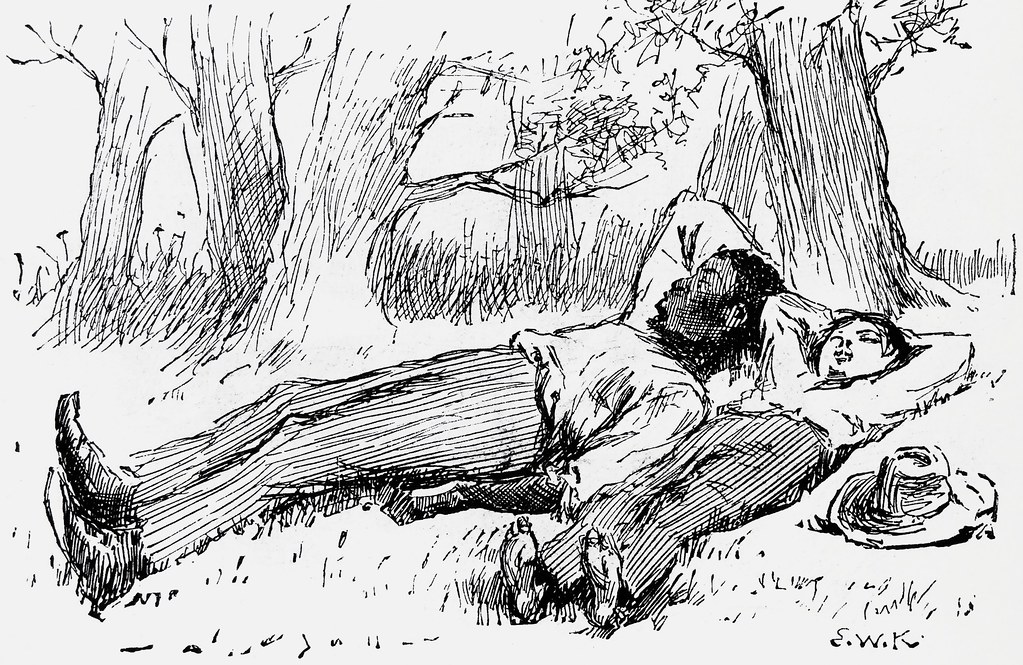
Huckleberry Finn escapes a supposed religious family. He rejects a great sum of money, feigns his own death and goes adrift on the Mississippi:
“I got out amongst the drift-wood and then laid down in the bottom of the canoe and let her float. I laid there and had a good rest and a smoke out of my pipe, looking away into the sky, not a cloud in it. The sky looks ever so deep when you lay down on your back in the moonshine; I never knowed it before.”
He meets Jim, someone who likewise escaped a state of subjugation, that of slavery.
In ‘the Still Small Voice’ prof. Donald Carveth develops a new kind of (post-)atheist Christianity. That is, Huck abandons the supposed religious family, and does so by virtue of have an intuition of goodness. In fact, both Huck and Jim are interested in a different life and find a voice that removes them from their environment. Carveth calls this voice conscience. Conscience, rather than persecuting the individual as it might do in the form of splitting or fettering oneself with conceit, greed, hatred, is reparative, affirming and liberating.
The argument for Christianity or atheism is subsequently not about what one claims to believe. What is important is whether someone is responsive to this voice, and is so over what Carveth calls the superego or some destructive, persecutory agency. There is the fundamentalist or superegoic Christian, and likewise a fundamentalist or superegoic atheist. They both operate on what Melanie Klein called the schizoid-paranoid position of the mind. This position is filled with persecutory guilt, and makes use of harsh judgments to oneself or others through splitting. Splitting happens when someone is seen as either perfect or as completely bad. The Carvethean challenge, and also interpretation of Christianity, is then to overcome such a type of christianity or atheism.
What this amounts to is a conversion to abandon persecutory guilt. And to instead move to reparative guilt. In reparative guilt, rather than harshly blaming oneself or others, there is a movement to repairing the situation. And it is through this reparative guilt that also a different type of spirituality can be found. One in which there is also a sense of divinity, to be found in some ineffable, and yet more uncertain experience of nature or elsewhere. This experience may nonetheless lead to a conviction or faith that there is some fine- or immaterial goodness that can orient oneself in life. It is what Huck seems to experience on the bottom of his canoe.
And so it is one who has turned away from a one type of religious family and its doctrines, that has found a different type of spirituality that is more utterly ‘Christian’. It is in fact also to be found with Jesus who doesn’t abide by the religious laws of a jewish community:
“You make God’s law to mean nothing so you can keep your own laws!…He said, “These people respect me with their mouth but their heart is far from me. They do not mean it in their hearts when they worship me. Their teachings are only the words of men.“ (Matthew, 15:6-9)
“And they were astonished at his teaching, for he taught them as one who had authority, and not as the scribes.”
(Mark 1:22)
In effect, both the scribes and Jesus considered each other to be non-believers. The first in the sense of not adhering to an explicit belief or script, the second as to what is happening on a deeper level. Merely adhering to some laws or rituals doesn’t mean there is some orientation towards goodness, forgiveness, reparation. It is removing the spirit from the letter.
And this really implies a dialectical synthesis refuting a supposed contradiction between atheism and theism. It is a paradigm which seeks to overcome fundamentalism and persecution through forgiveness and an intuitively nourished sense of the good. It is apophatic in that what is looked at from the canoe is signless. The descriptions are mere signs pointing in some direction that through practice will have to be discovered. Believing or holding on really hard onto some thing we think to be, or have to defend, is what the scribes did, and it is what needs to be left behind.2
Using these teachings some six to seven years ago, and practicing on it, was what eventually lead to me stumbling into the teachings of the Buddha. But ever since discovering and studying that, it seems I can’t help but owe a great deal to what I found here.
Article:
http://www.yorku.ca/dcarveth/christianity.pdf
- If there is no ‘God out there’, then such belief would have to be understood on the level of psychology. Freud believed that God merely had functions for the psyche, allowing for a certain order to manifest. However, if God is to be understood on the level of psychology, then insofar as one is subject to idolizing, one would be a religious believer in this sense as Freud describes. It means that this function of God can be replaced with a faith in Science. Psychologically, it would operate on the same level with the same significance. To overcome that type of thinking, which really is to deepen a kind of atheism, a different understanding is required. ↩︎
- In the teachings of the Buddha, there is gross-materiality, fine-materiality and immateriality. Right view is understanding that there is goodness and there is the stressful. There is generosity (towards mother and father), the fruits of wholesome actions and the fruits of unwholesome actions. The right intention or inclination is: good-will, harmlessness, and renouncing or distancing. If there is harm, one can use intentions of goodwill and harmlessness to cultivate an intention of distancing. ↩︎
 Meditation