
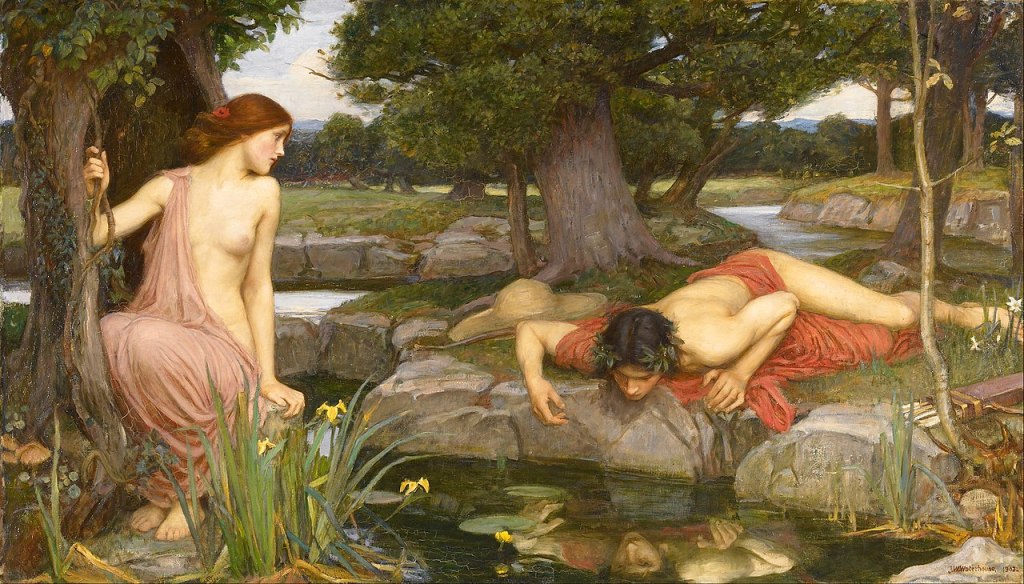
Ever since learning about narcissism, the whole thing has felt abhorrent. Various Christian thinkers pointed to this not as something that only a few would deal with in terms of a diagnosis. Rather, they assessed it as the fundamental human problem.
The idea felt abhorrent because it felt as though this assessment was true. If it was true, then who wants to be the person stuck looking at their own thoughts, reflections, eventually drowning in them, while in the meantime life as it is actually happening is flying past. And moreso: the life that is missed out on, is actually turning into an echo of what could have been. That is to say: it is done injustice to. This is because is the freedoms between the individual and the larger meshworks of society and nature dependently co-arise.
It seemed vital to find anything to overcome such a condition. Allthough such a thing is never fully possible, it is possible to make very significant changes. Over the years, what started happening was a change in perspective. Persecutory and idealizing guilt or effort made way for reparative guilt and effort. In an interview with my meditation teacher, Leigh Brasington, I ask him about what I by then found out are these heavenly mental states, known as jhana’s. And I ask him what he feels, looking around and what people do to each other, knowing the availability of these states, and he basically shrugs his shoulders saying he does the best he can.
It reminds me of the Cave-octet sutta. It is reminiscent because there is an enchantment and infatuation with what is thought of as self. Yet it only leads to despair and loss of what is actually happening. What is thought of as the ‘thing out there’, actually is a perception reflected on consciousness, conditioned by that consciousness, in varying degrees clouded by that consciousness. If there is grasping and holding on to these perceptions in clouded conciousness, it can turn into a whirlpool of distractions, and one can drown in them. Once there is grasping, that very moment of grasping constitutes an entanglement between the consciousness with the perception. Craving has thus stitched two things together. If, rather than clinging to objects within the mental theatre, or the mental state, there is a focus on developing a translucidity of the mental theatre – allowing things to pass without judgement – or even changing the mental theatre or state by developing compassion, allowing for differing perceptions to arise, one can start dissolving the whirlpools.
Craving to control the image, life escapes its grip or dies.
Craving to destroy the image, the repressed comes back stronger.
Craving to proliferate the image, there is becoming otherwise.
Translation by Laurence Khantipalo Mills, the monk who supported Ayya Khema through most of her bhikkuni life. 🌼
4:2 The Cave Octet
The person who’s to their body-cave
Clouded by many moods, and in delusion sunk,
Hard it is for that one, far from detachment,
To abandon sensual pleasures in the world.
Bound the worldly pleasures of the past,
And hard to liberate are they in future time,
From others they’re not free, not liberated—
They’re attached to past and the future too.
Those who are niggardly, who hank after pleasures,
infatuated they are, all their things—losses all!
But subjected to pain they lament their losses—
For how can all this be taken away, they wail?
Therefore should a person train,
Seeing the roughness of the world,
To take not to a wicked way,
For the wise say, life is short!
I see here trembling, fearful in the world,
These people gone under the sway of craving for births—
Base people floundering in the jaws of death,
Not free from craving for repeated birth.
Look at them trembling with their egotistic selfishness,
Like fish in a stream fast drying-up,
Seeing it so, fare unselfish in this life,
And cease worrying on different states of being.
No longer longing towards either extreme
Having understood touch, together with letting go,
One should do what others will praise and not blame,
A wise one is not stained by what is seen and heard.
The sage has known perception and crossed the flood,
So with nothing tainted, nothing wrapped around,
They fare on in diligence with the arrow drawn,
Neither longing for this world nor for another.
 Meditation
Leave a comment